Sunday, December 19, 2010

Hamamat Ma'in Springs

Madaba to Hamamat Ma'in

Distance: 27 km
Time elapsed: 1:33:00
Average speed: 17.4 km/ hr
Max speed: 67.9 km/ hr******
Temp: 19 C
Weather: Cool and breezy day, very chilly night

I woke before sunrise to the singsong sound of a nearby imam, bellowing verses of the Quran over the loudspeaker. It has happened several times along this trip, sometimes in the cities this wailing voice will make it's way into my dreams, finally disturbing me enough to half wake in confusion. Then I realize who is singing (reading really) and roll over to catch more zzz's.

Today we got up and slowly converged in the family's warm tv/kitchen room with Seleh, Ismael, and the older children. The younger ones begin school at 6:30 for the first shift and the older kids go after they finish, around 11, that is how crowded the neighborhoods are. Chris and I ate breakfast with the fathers and then departed as they left for work, only able to get their contact info as their names @ West Camp, Madaba.


Chris, Saleh, and his children

Already near the edge of town, we cycled up and over a few hills toward Ma'in, a small cluster of homes about 10 km away. Hoping to stock up on food for 3 days and nights of wilderness camping, we could only find one tiny market of junk food, though there was a dusty can of beans and a box of milk (did I mention my cereal gift from Eric?). Chris got a few snickers bars and we had enough fruit and pide so we biked on.

Over a few more steep climbs we found ourselves suddenly along a ridge, overlooking a vast sandy brown valley. From here on out we sailed, mostly downhill, flying at our fastest speed yet of 68 km/hr!


Chris zooms through the desert

At the turn to the falls we debated awhile about biking down the steep 3 km stretch and having to backtrack later in the dark (not my vote) or leaving the bikes uphill and taking necessary supplies with us. We decided to lock the bikes in shallow holes up near some electric poles, and just as we began walking a car pulled over to drive us down.


Biking back uphill would have been very, very annoying

The entrance to the springs complex (which is now a hotel resort) set us back 15 JD a piece ($21), which is outrageous considering the facilities. But still worth it; we soaked in the giant waterfall and pools for a full six hours, emerging as pruned up (but relaxed) sacks of wrinkles.


Hammamat Ma'in falls

There are 3 waterfalls in the complex: 1 public (where we hung out, along with several pot bellied men, no women), 1 family fall (where a few women took pictures but we never saw children there), and 1 for ladies. I envisioned this females-only area to be a scene not unlike the ancient Turkish baths, unhindered women lounging in their skivvies, frolicking in the freedom of malelessness. I said See ya to chris and began marching up the path, approaching a small steaming stream crossing the road with a row of older women soaking their feet. They sat stifly, fully covered in heavy coats and scarves, only bare from the ankles down. I timidly stepped passed the line and up to a gate labeled Ladies Waterfall, aha! So they are hidden behind closed walls, of course. I pushed open the rusty gate to see an enormous waterfall cascading into a wide, semi shallow pool. But no women. Nobody. I guess the ladies prefer soaking in the street rather than a private tub, weird.


Ladies' waterfall (where are the women??)

I quickly U-turned and joined chris back at the public fall, where we stayed even well after sun set. We rotated frequently between sitting under the pounding water, which is supposed to feel like a massage (not for me, it felt like being sprayed with a firehose), swimming around the two lower pools, and soaking in the sauna cave above, where the source of the bubbling water emerges.


Hot waterfall pounding massage

The moon rose from behind the canyon walls, helping to illuminate the area. We picnicked on our remaining hummus and pide, as well as some boiled eggs a Korean man pulled out of a basket at the spring source. So that's why hot springs are stinky!


Moonrise over the waterfall

Finally, closing time (9:30) drew near, we hopped out and shuffled up to the changing room to put on dry clothes. Getting out of hot water is always cold, but getting out of hot water at night in the desert is really cold! We had just walked out to the empty parking lot when the last car turned to leave, thankfully they pulled over and offered us a ride. The passengers definitely thought we were a little crazy to be walking up to a deserted highway so late in the night, until we explained we are camping and our stuff was stored up the hill. They let us out, pulled away, and seconds later returned, jumping out to shove oranges and a pomello in our hands before wishing us a good night.

This is the only highway I've comfortable slept near, probably because we set the tent on a plateau well above an almost completely empty road. After all that soaking it was pretty easy to drift off to sleep...

Saturday, December 18, 2010

Building with Straw

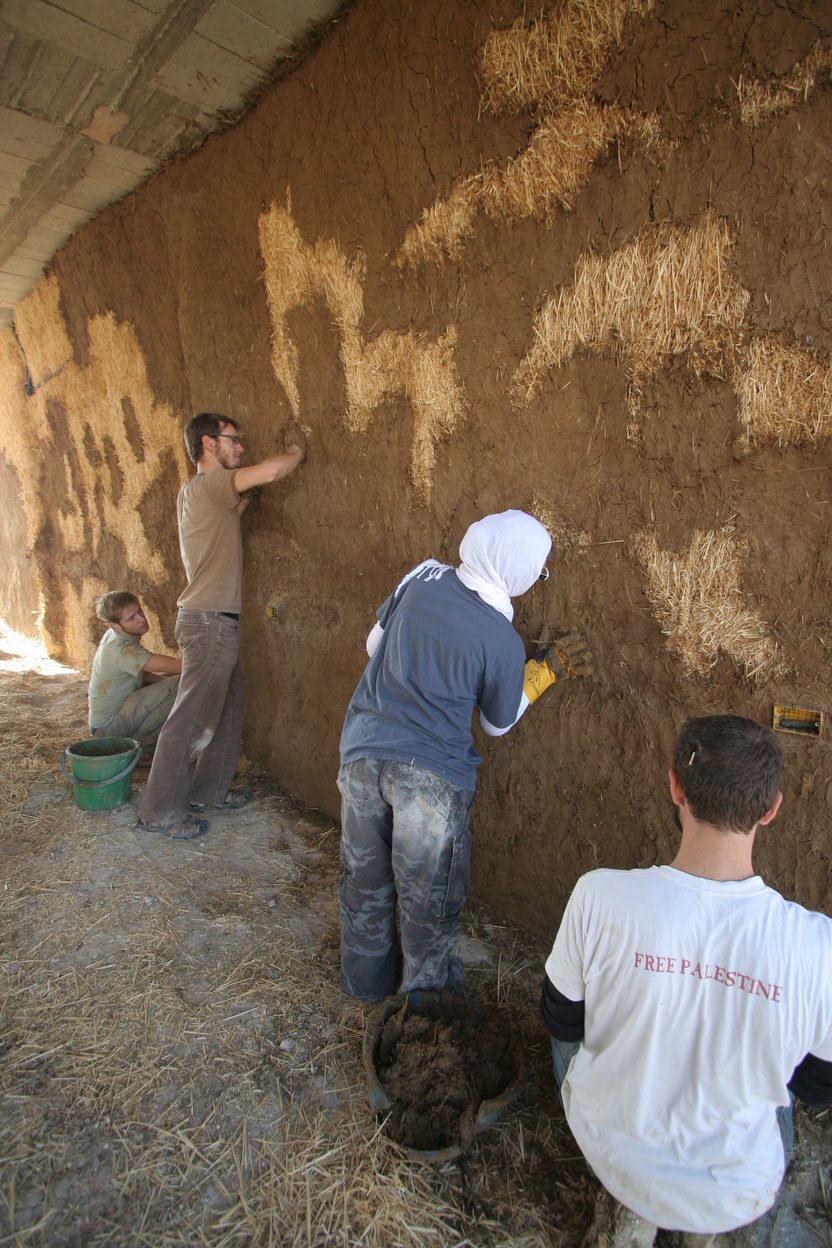
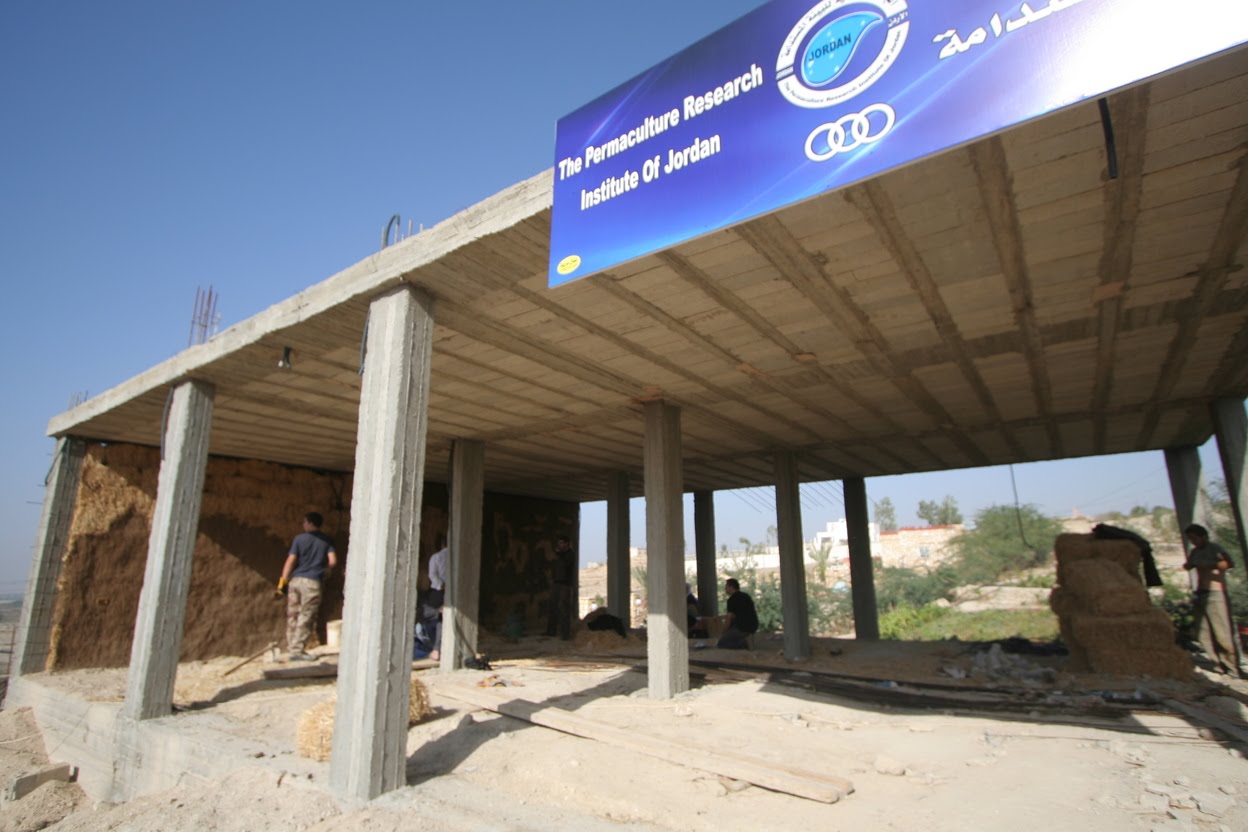
Chris and I joined back up with Anselm and Dan in Al Jawaseri, northwest of Madaba and near the Dead Sea, to help cobb one of the walls of their strawbale project.


Future Jordanian Permaculture Institute

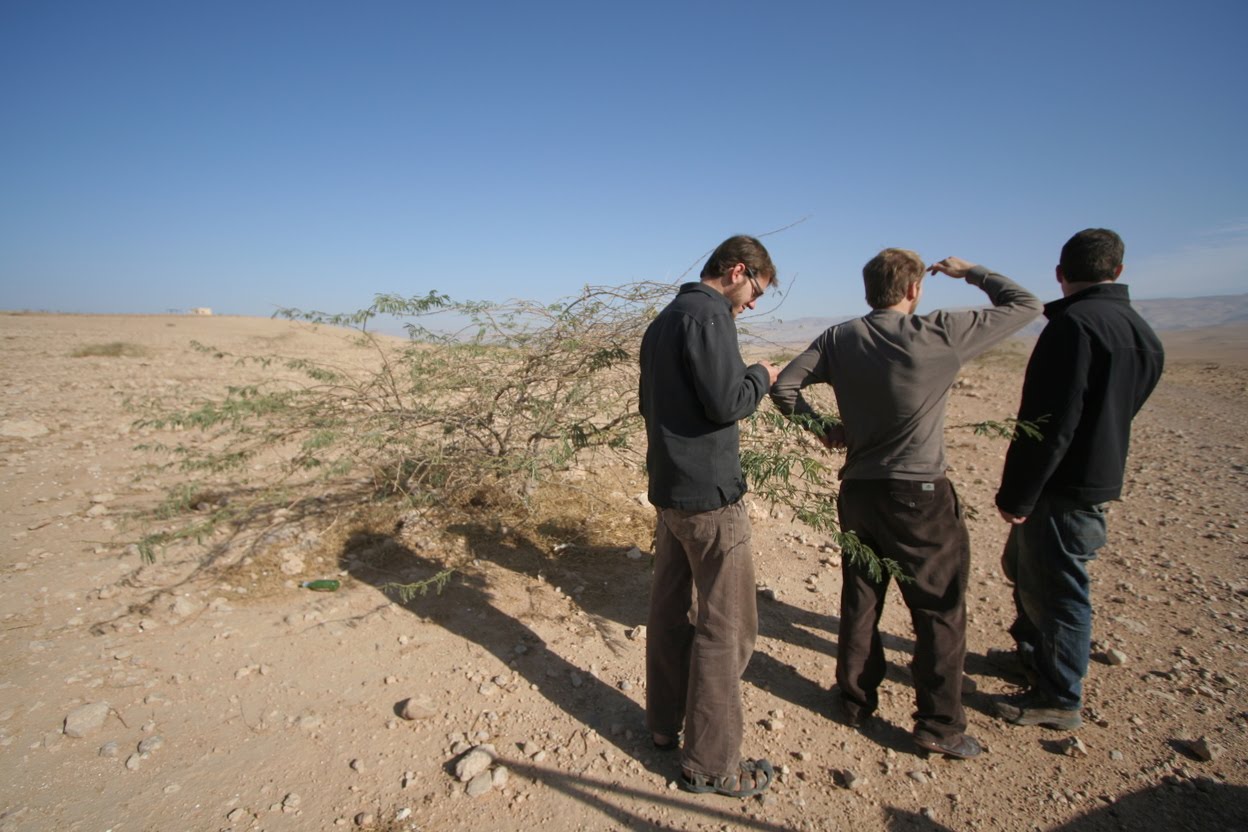
The guys picked us up early in the morning from Madaba, and together we climbed up (in their car al-hamdulilah) over Mt. Nebo, where Moses supposedly heard God speak while looking over the Holy Land and where he later died (at the ripe age of 120). From Nebo the road descends with switchbacks into the dry Jordanian Valley, occasionally dotted with herds of sheep and camels. We stopped a few times to admire and wonder at the few desert plants that have managed to survive in such a harsh environment; many were familiar to Chris from some of his classes in Tempe.


What kind of tree is this and where did it come from??

The strawbale project is in conjuntion with the Jordanian Permaculture Institute and Australian Permaculture Society, who recently came to host a workshop. The building and grounds will become a test site and future location of the Permaculture Institute, hopefully hosting many more locals and foreigners who want to learn sustainable building and farming techniques. Geoff Lawton, one of Bill Mollison's students (BM is the founder of coined "permculture"), developed an esteemed desert conservation system here in Jordan, married a Jordanian woman and now runs his NGO here, so hopefully their efforts will continuously expand. (Watch Greening the Desert if you can)


Permaculture garden


Cobbing team

Along with a few Jordanians and American-Jordanians Chris and I helped cobb one of the first walls, delayed only slightly by problem solving the wall's leaning. The muhandas (engineer) who refuses to be called a muhandas, rigged up some horizontal poles to hold the wall in place until all the cobbing is finished, and we continued to slather on batches of mud-sand-straw mixtures.


Anselm and the non-muhandas muhandas fix the leaning wall


Hearty lunch for hearty workers

The work is tiring but very empowering- I can go build my own house I'm sure of it now!- and we feel energized by such motivated people. Our group worked late into the evening, finishing the last patchy layers by electric light.


Finishing the cobb wall at night

To celebrate a job well done, and because the opportunity arose, Anselm, Dan, Chris, and I ate dinner at Haret Jdoudna. Anselm ordered all the Jordanian mezzes we simply must taste, and together we feasted on specialties like fattoush (toasted pida salad), sawani (meat and eggplant baked in a clay dish with yogurt), and spicy, garlicky yogurt. Nearby a duet of live music, one man with the double-stringed oud and the other man on tamborine, filled the room with ambiant and lively Arab sounds.


Dinner with Dan and Anselm at Haret Jdoudna, Madaba

Friday, December 17, 2010

Mosaics in Madaba

Amman to Madaba

Distance: 38.4 km
Time elapsed: 2:19:00
Average speed: 16.6 km/ hr
Max speed: 54.7 km/ hr
Temp: 14 C
Weather: Sunny and windy

Once out of Amman Chris and I climbed several sets of hills along the highway heading to Madaba, a Christian town known for the amazing mosaics discovered covering several of the area's church floors. The city's downtown is quaint, lined with several tourist souvenir shops and restaurants, and with an easy walking route between the churches, now-delapidated-but-once-fabulous baits (homes), and museums.


Chris and the Madaba Christmas tree, lit by Jordan PCVs


Madaba's touristy streets

We arrived with plenty of time to stop in St. george's Greek Orthodox Church, which has an ancient floor map of the Holy Land. The map previously stretched 15 m across, though now only about 1/3 remains and it it badly faded. However, Mt Nebo, the Dead Sea, Jerusalem, and the Sinai are all still clearly visable. The walls of the church are decorated with mosaic biblical scenes and people (99% men) which we assume were produced by students in the nearby mosaic school.


Inside St. George's church, full of mosaics!


Mosaic map of the Holy Land


Only female in the church's mosaic collection (Arlene: 10 points if you can name her)

We wandered through the city neighborhoods, discovering some ignored mosaics and talking with some English-speakers we met on the street, before ending with a quick look inside the Church of the Apostles, a warehouse-looking building with nothing inside save the enormous stretch of Byzantine motif mosaics.


Mosaics in the Church of the Apostles


Girl making mosaics in a Madaba shop

With nowhere to go and hours to kill, Chris and I splurged for dinner at a fancy restaurant in town, Haret Jdoudna (lit: ancestors neighborhood). This restored house now serves upscale Jordanian entrees and hookah, and features several local artisan craft shops. We ordered hummus, mutaffi bethanjan (fried eggplant with tahini), and spicy lamb sausage which came with a basket of deliciously hot and fresh mini pides. Almost completely empty of diners, the restaurant was festively decorated with Christmas frills and played upbeat Arabesque broadway musicals (instrumental, my guess was Mama Mia but Chris says its traditional Arab music).


Haret Jdoudna courtyard


Inside the Haret Jdoudna ma'taam (restaurant)

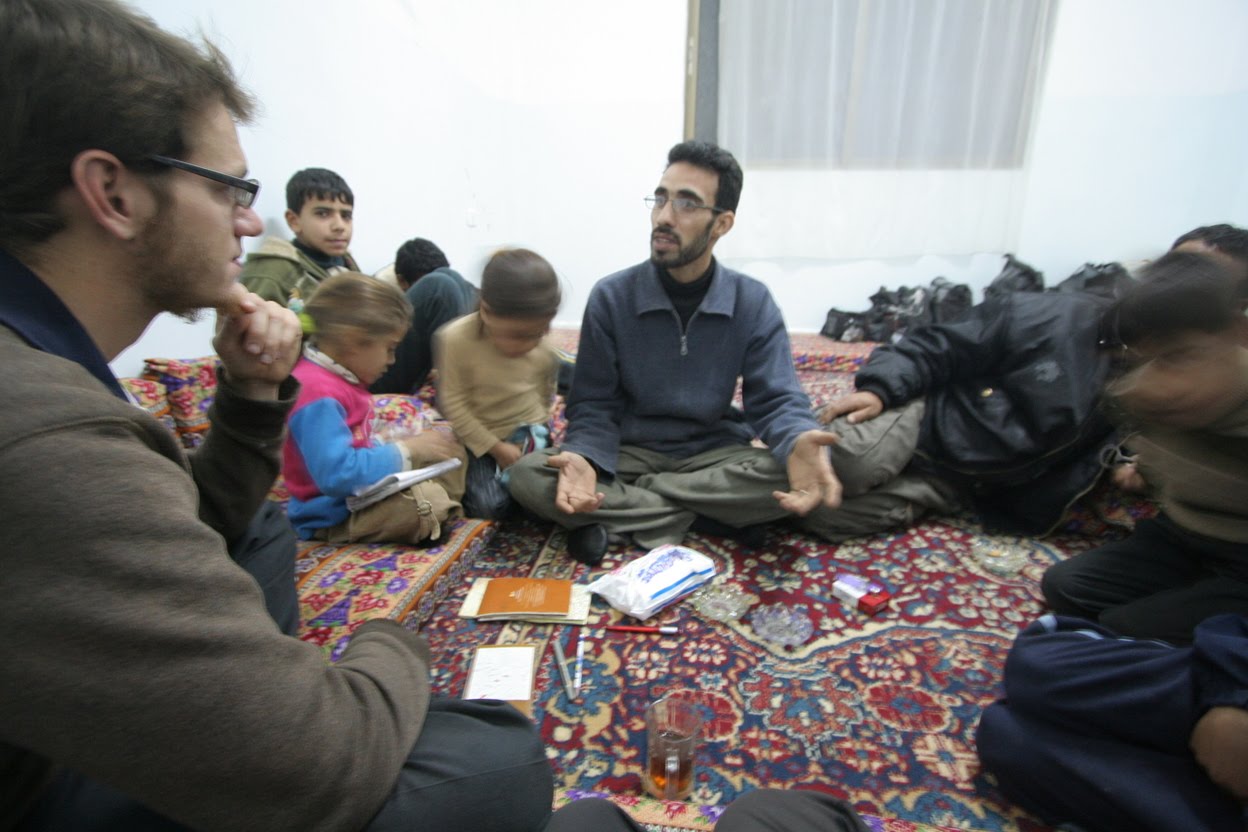
Now dark, we began cycling out of town to find a place to camp, hoping to find an olive grove at the edge of town. At the outskirts a van pulled over and two men leaned out to ask who we are and where we were going, almost immediately saying no, come home with us! So we followed them into a narrow city block and up some stairs to a spacious living room which quickly filled with children. In this 3-story house live 3 brothers and their families, with anywhere from 6-10 children each. Ismael, the youngest of the fathers and best English speaker laughed at our shock, saying this is their own basketball team.


Ismael and his kids, talking about Palestine

The family is actually Palestinian, which make up the vast majority in Jordan, whose parents came to Madaba in '47. They explained that their parents had a large home and lots of land with olives and grapes so good that 3 would fill you up. They even showed us the key their mother carried away with her, saying someday they dream to return and open the door to their family's house...


Key to a long lost home in Palestine

Tuesday, December 14, 2010

Mud Storms in Amman

As-Salt to Amman

Distance: 50.1 km
Time elapsed: 2:05:00
Average speed: 17 km/ hr
Max speed: 55.8 km/ hr
Temp: 23 C
Weather: Sunny and warm, then windy-dusty-snowy, then warm again

Chris and I stayed a few nights in Jordan's hilly capital, Amman. We were lucky to bike in on a sunny day, climbing along the highway lined with American fast food chains, namely the golden arches, Burger King, Hardy's, etc. This is truly a sign of development right?

Our first stop was the peace corps office at the 4th circle. Amman's main street is Zahrain, which has 8 roundabout reference points. From 2nd to 1st circle are the shwanky cafes and bookshops frequented by a large foreign clientelle; this leads to Rainbow st where the tourist shops and western style restaurants line the emaculately clean road.


Amman's streets begin to fill with dust

The Peace Corps office was closed (suprise! It's Friday!) so instead we met with one of the volunteers who took us to the financial administrator, Ledina's, house. We heard she is Albanian so we felt compelled to meet her, and glad we did. So nice to talk with someone about things we know and love (or hate, as when the topic of politics and Sali Berisha came up)! Ledina moved to America in 97 just after the pyramid scheme threw the country into another chaos. Her husband worked for Peace Corps in Lesotho with our own country director, Hill, (imagine Disney's Its a Small World playing in the background) and they've been immersed in the Peace Corps network ever since. L and E were nice enough to host us a night, allowing lengthy conversations of all things Albanian and plenty of time to find out what life is like for them in Jordan. Eric even gave me my first Christmas gift: Optimum cereal. My eyes lit up like saucers when I saw the box, I think he sympathized from his days as a volunteer in Nepal.


Merry Christmas from Amman! (Borrowing Ledina and Eric's tree)

We also stayed a night with two volunteers, Edison and Marty, who we hope to see again in their own villages further south. After cooking and eating a smorgasbord of dukan (corner shop) delicacies, we managed to chow down an entire bag of CarreFour gummy bears between us while talking about the PC Jordan experience.


Canned cron soup and pasta with Marty and Edison

The majority of our time in Amman was with a fantastic household of couchsurfers. Two guys and one girl, they work for an environmental company called Entity Green. The company began by training and employing Iraqi refugees with technical skills and has moved on to organizing a country-wide recycling program. We admire the sustainablilty of EG because it does not rely on foreign aid with an expiration date.

Their house, complete with a gray water system and outdoor compost, is near the downtown bookshops on Rainbow Street, overlooking the downtown wadi full of Roman ruins. Our three hosts are incredibly diligent workers, each with their unique skills and backgrounds. Anselm, originally from Germany, studied water resource management, and is extremely knowledgeable about Jordan's water crisis. He stars as Abu Selim in a hilariously entertaining educational film that aims to teach people why and how they can conserve water. Dan, from the States, specializes in composting and has started a project branch in the company to do large-scale composting. And Jo, from France, has an art background and contributes her skills creating package designs and usable recycled goods for EG, such as recycled Matweebo books, in collaboration with a group of impoversished Phillipino women in the southwest.


Cheers to new friends, good food, and free wine (from left Anselm, Jo, Dan)

The group recently completed a permaculture course sponsored by the Australian permaculture society, and have already begun putting their new skills to use by designing a reforestation project near the Syrian border. The land is part of St George's vineyard, the largest wine producer in Jordan. There is very little rainfall in this region (well duh it's a desert) but with clever planning they will create an ecosystem that maximizes swells and water flow to retain moisture in the soil.


Measuring dimensions for swales in the future permaculture forest (St. George's vineyard)

Anselm, Dan, and Jo are also working on a strawbale building and permaculture garden near the Dead Sea. Such an inspiring group!

Shortly after arriving in Amman a brutal rain and dust storm moved in, alternating between drenching showers and thick gusts of sand and dirt.


Only a taste of the beast to come

Normally dust storms begin in the spring, called khamseen (fifty) because they last fifty or so days. This storm lasted only three days, covering everything (including our bikes) in a thick layer of mud, and dropping temperatures low enough to see snow.


OMG is that snow?? We are not prepared for this!

Despite the cold and wind, Chris and I managed to wander down into the wadi to explore Amman's historic relics. We started in the suq, distracted as always by bustling produce markets, then made our way to the ancient odion and Roman amphitheater. Everything seems to be inder construction, adding even more dirt and rubble to stir up in the wind.


Column details in Amman's Odion


Chris withstanding the winds outside Amman's Al-Husseini Mosque

Finally having enough of the cold, Chris and I climbed back out of the wadi and swiftly into a nearby bookshop to browse for a few hours. It's been over three years since we've had the luxury of sifting through a contemporary, English-language bookstore-- quite exciting for us both. And we could hear English everywhere! Amman has a large student and expat community; it was incredibly difficult to not eavesdrop on nearby conversations. I guess I've grown used to the constant foreign murmur surrounding us, so this pool of chatter seemed amplified and obnoxiously intruding in my thoughts...


WiFi in a tres chic bookstore cafe (black coffee: $4)

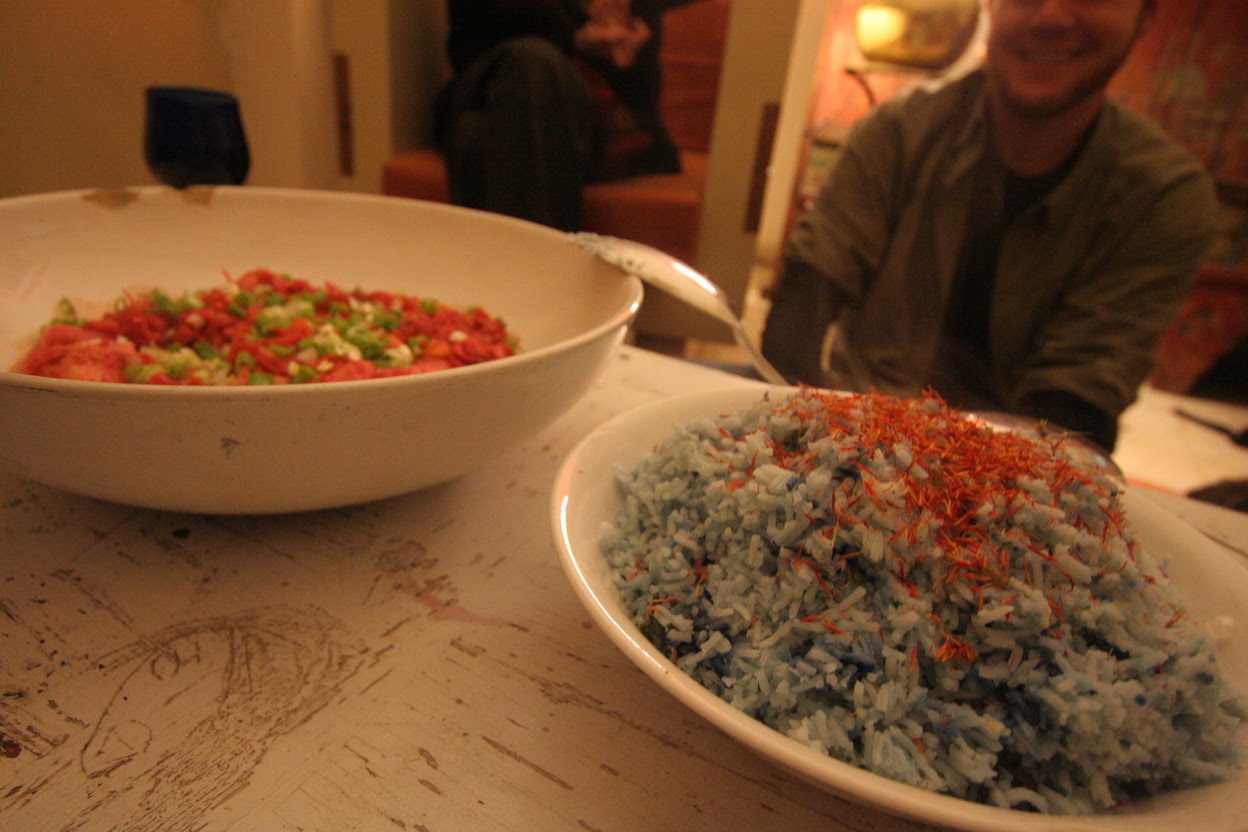
One night we had something of a dinner party with a group of Swedish girls living in Amman for various studies and jobs. Jo cooked up a deliciously complicated Thai ginger fish with blue rice (dyed naturally with blue Thai flowers while cooking) and I baked simple veggie patties, creating a vibrant collage of pinky-orange, blue and red, and green.

Dinner party with the Swedish gals


Blue rice with saffron and pink ginger fish, courtesy of Chef Jo

Before leaving the capital we did manage to swing back to the PC office, to pershendes (greet) Ledina, as well as check out the facilities. As soon as I walked into the volunteer lounge I spotted several copies of the Peace Corps Times, a quarterly newsletter about volunteers distributed all over the world. Smack dab on the front of the top page I saw my best friend, Anne's, smiling face-- a spotlight on her great work she was doing in Guatemala. What a sign! To be so far away after all this time and find her photo...


Surprise! That's Anne's photo in the Peace Corps office in Jordan

Luckily the weather improved and the sun returned to Amman's steep jabels. We biked out on a sunny day, making our way south toward Madaba.

Saturday, December 11, 2010

Northern Hashemite Hills

Bosra to Al-Husn to As-Salt

Distance: 77 and 55 km
Time: 3:31:00 3:51:00
Max Speed: 45 and 51 km/hr
Ave Speed: 22 and 13 km/hr
Temp: 27 and 22 C
Weather: Getting cooler day by day... first days of rain!

The vast difference between Syria's flat, arid land to Jordan's super
mountainous jebels (mountains) and wadis (valleys) is startling, and a major bummer for bicyclists. We noticed immediately how challenging and slow the next segment of our journey would be, though maybe we just got spoiled in Syria and it seems harder than it really is.


Welcome to the Hashemite Kingdom

Chris and I stayed a few nights in Al-Husn, with our new Peace Corps friend Lydia, who teaches English to engineers from the surrounding villages. She regaled us with stories about her cultural adjustment and how she copes with such a conservative society, how the peace corps flow is for their group (very different from ours), vignettes from her pre-service training in a small bedouin village, and a wealth of information about modern Jordanian life. Really an awesome woman, I'm so impressed with her positive spirit and upbeat attitude that I sometimes think requires a lifetime to develop.


Chris and our first Peace Corps hostess Lydia, Al-Husn

We did manage to get out to a nearby castle, Ajloun, which sits on a forest-covered hilltop overlooking the sprawling city of Ajloun. We took a cheap bus there to avoid a roundtrip day of hills and the pouring rain and cold weather. Otherwise the weather was rainy on and off so we hunkered down with Lydia, cooked a bunch of meals together, listened to her play the guitar, baked oatmeal raisin cookies for her tutor who canceled so instead ate them ourselves, and occasionally took a walk downhill to her market for provisions.


Hot drink on a cold day


American-Jordanian breakfast: french toast wheat pides

The sun did return, allowing us to head south on the main highway. It took well over an hour to climb a long, steep jebel, which then took 5 minutes to coast down the other side. This pattern of 6 km/hr uphill followed by a quick 50 km/hr downhill rush continued for a few hours.


Mighty jebels of Jordan

I'm utterly amazed at how dramatically different the scenery is here; terraced olive groves set over endless hills in all directions. Even the buildings are in another style: painted! We passed through the town of Jerash, where a huge set of ancient ruins sits smack in the city center (we didn't go inside; I'm a bit ruined-out for awhile), then continued to a small town set on the edge of a cliff, called Suweila. From Suweila we could coast down several hills toward As-
Salt, where another peace corps couple awaited us. We eventually took a ride into town with a nice English speaking guy, thankfully, because we were unprepared for how steep Salt's hills would be. He generously took us right to their house, which is on a cliff overlooking a deep valley. Biking is not an option here!


Those are some steep hills

We stayed a few nights with our hosts James and Shaylyn, who are english and youth development volunteers. They have created a whole program they call Brain Camp, which engages students in critical thinking games and problem solving activities in a style completely outside the structured realm in Jordan. From our many discussions it seems the Jordanian school system is similar to the Albanian school system where students are taught using rote memorization and, even though they can correctly regurgitate entire paragraphs on a test, they are stumped completely when asked to dissect real information.


James and Shaylyn on the balcony


Tis the season! Our first (but not last) Christmas tree

James also took us on the official Salt Heritage Trail, a winding path up and down the neighborhood to glimpse the large Ottoman homes around the core of the city. Salt was once the provincial capital, and would have become Jordan's capital city if the railroad hadn't been built connected to Amman.


Deciphering Arabic doorway inscriptions on one of Salt's old homes

The city's newly opened museum, in the Abu Jabber house, is quite impressive, with displays of old photographs and great English-translated texts documenting Salt as an extension of the Ottoman empire, as well as it's long-standing connection to the great Ummayid Caliph in nearby Damascus. It has always been a chief trader of goods between Turkey and Egypt, and is known for growing a special type of raisin, the Sultana.


Salt's downtown wadi, modern buildings crowd the Ottoman mansions

As the sun set we wandered down back into the center wadi and through some narrow alleyways full of shops, all the while being stopped by young boys James knows through his youth groups or random connections. A big thing in Jordan is the system of wasta, which is the power one has depending on how well-connected one is through friends and family, etc. To get anything done people often "call on their wasta", which means they have some long-winded relations to someone with the power to make something occur. It's not so much a system of favors, more like obligations to help other tribe members. Anyway, James has gained a lot of wasta!


James builds his wasta as we tour through town

Shaylyn and James stayed up late into the night talking with us about all kinds of interesting things. Both are practically geniuses, having graduated from Harvard and Columbia, and impressively well-spoken considering they speak Arabic most of the day. I think by my 3rd month in Albania I had almost forgotten how to complete an English sentence and it was all downhill from there...


That's us in Salt!