Wednesday, November 17, 2010

Crusader Krak (Al-Hosn Citadel)

Our campground was perfect, isolated, and let us wake to the sunrise over the valley; however, I still didnt sleep a wink. When camping I rarely sleep at all, almost always suffering insomnia, though I don't know why. I watched the moon slowly crawl across the sky, until the blue light faded to pink and orange.


Awesome campspot!

We had a few hours to kill before the castle opened, so chris slept a bit later while I sat at the cliff edge, watching the slumbering town. Yesterday we came across many cactus fruit, which are undoubtedly the most difficult, painful fruit to eat-- but very tasty. Like a surgeon, I carefully cut apart the thick flesh to extract it's sweet center, trying very hard to guard my fingers from the invisible, hairlike thorns. Unsuccessful.


Watching the sleepy town from our hilltop

Once packed up and inside the castle, we followed it's outer cooridor past an inner moat, underground hamams, and guard towers, then climbed up on the walls for views of the outside valley and larger inner fortress.


Looking at the inner citadel from the outer citadel


Sunshafts in the hamam


All-purpose storerooms, lookout posts, kitchen space and who knows what else

Al-Hosn citadel is one of the most impressive crusader castles (according to CS Laurence but I agree), dating to the 11th century and later taken over by Islamic forces under Mamluk Baybars in the late 1200s. It's enormous size allowed for over 4000 troops to fit inside, with many large stables to accomodate their horses.


One of 2 stables, roomy enough for 2000 horses


Christian crusader motifs outside the chapel


Valley and outer citadel view from the guard tower

After soaking up as much crusaderness and valley views as we could handle, Chris and I coasted down the steep, winding hill toward the highway. The road cuts through a narrow, congested town full of pickup trucks and children. All of the little boys were armed with cheap plastic rifles, which I found highly disturbing. Chris assures me that he played with toy guns when he was young, but it still seems odd that every single boy in town has a gun and is practicing/ learning how to shoot and kill (this is not a Syrian or Arab comment, but my criticism of how boys are socialized).


Overlooking the castle square from the guard tower


One of many stone cooridors to explore


Another great view, its enormous!

Anyway, we left the boys and town, dodging their tiny plastic bullets (only one hit me) and found our way back to the tree-lined autostrade. Chris befriended some guys on their front porch, likely gathering for Eid celebrations, who let him pick some oranges from their tree. We took the fruits to a thick patch of trees, sitting in the shade to rest and enjoy the quiet fields before heading to the highway.


Biking dowhill is muuuuch easier...

Tuesday, November 16, 2010

Krak de Chevalier

Rrustan to Qalat Al-Hosn

Distance: 65 km
Time elapsed: 3:58:00
Average speed: 50.8 km/ hr
Max speed: 17.2 km/ hr
Temp: 20.5 C (night)
Weather: Warm by day, cool by night

We woke early with the sun, plugged in the radio, and in proper Syrian fashion listened to the morning melodies of Faruz, the infamous Lebanese singer. Between 6:30 and 8:00 am her voice can be heard from every Syrian house...


Chris and Isa outside his summer home

Isa returned as promised and drove us back to his house in town where we shared an Eid breakfast with 3 generations of family on the front porch. Little girls dolled-up in fancy shawls and shiny purses came by, asking for Eid coins.


Sharing Eid breakfast with Isa's family

As we left town one of Isa's sons took us (ie. guided on his motorbike) to his friend's house and invited us to watch them slaughter a cow. Chris stayed but I politely and swiftly escaped, walking down the street and trying not to hear the cow's bellows. I'm totally fine with people doing their thing, following centuries-old traditions, and killing animals humanely for the consumption of the meat-- but completely unwilling to watch the slaughter, not even for so-called anthropological observation or a Lonely Planet sidebox.

Moving on we biked the parallel road, a little taken aback by the extreme desolation and very not jamil surroundings (read: pretty ugly and full of trash). The road is almost completely empty of (what we consider usual) food stalls, markets, even gas stations, and the few that do exist are shut up and appear abandoned, though I suspect that is because of Eid.


Tree lined highway south


Is that SNOW?? nope, just a pool of chalk


Chalk paintings

Turning west near Homs, bypassing the city and following the ring road around to a highway skirting the Lebanese border, we continued toward Qalat Al-Hosn. Closer to the citadel's turnoff, the still-smooth highway slopes downhill, allowing us to coast several km into the sunset.


Luckily the water never stops flowing at the mopsques

Al-Hosn, otherwise known as Krak de Chevalier, is a large crusader castle, still mostly intact. Syria has many crusader castles, however Al-Hosn was made most famous by Lawrence of Arabia's memoirs.

We took a short break at an abandoned roadside snack stand (literally everything is closed today for Eid, giving the impression that the country has been abandoned) before beginning the long, steep, uphill climb to the citadel. By now I was overly exhausted and not at all happy to drag my bike up 6.5 km at a 45* incline. I mean steep!

About half way up I couldn't handle any more and flagged down a passing truck, who happily drove us up through a congested town and dropped us at the citadel.


Moonrise under the arches at Al-Hosn

Just as the sun disappeared, Chris and I were the lone diners on the patio of Panorama restaurant. Overlooking the castle, Chris ordered himself chicken and we shared hummus and tortilla, then we set up our camp spot along the outer castle walls. Nights aren't too cold here yet, al-hamdulilah! (thank god)- but there is nothing to do once the sun is gone, so we went to sleep early. Like 6:30. That's got to be a record...

Monday, November 15, 2010

Near Hama to Rrustan

Near Hama to Rrustan

Distance: 78 km
Time elapsed: 4:21:00
Average speed: 18.6 km/ hr
Max speed: 34 km/ hr
Temp: 29 C
Weather: Hot midday, otherwise cool evening
When the sun rose, we packed up and followed one of the young guys we met last night, Tariq, to his family's house, sitting on the front porch with his 9 siblings and mother. Her hair and hands were painted dark red from henna, and face wrinkled with age. Most of the family was fasting, because this is the day before Eid, one of the two major Muslim holidays. This day celebrates all the pilgrims making the Hadj to Mecca, and families around the world sacrifice an animal (usually sheep) for a 4 day feast/rest.


Prelude to Hama's wheels

We easily cycled into Hama and spent the afternoon exploring the river's once-spinning wheels. Though the water level is very low and stagnant, at one time these wheels sucked (hopefully clean) water up to the aquaduct and carried it throughout the town.


Central park, dotted with old wheels

Chris and I wandered some markets from the modern town, bustling with people buying Eid sweets, then to a park outside the Old Town. Here is where the nicer wheels sit, rigged with lights to illuminate them at night. We walked around a few wheels, then through the old town's worn streets and into an artist's shop. The man inside has been painting Hama's streets and river for decades, documenting it's drammatic decline in bright, splotchy watercolors.


Chris contemplates great things at the wheels


Riverside view, once lined by enormous Ottoman homes


Mosque in Hamah's quiet old town

Realizing the day was half over, we left town and continued south toward Hims. As the light disappeared we were still on the highway; we wanted to find some food and camp, but no restaurants in sight. Unexpectedly, a city appeared before us, leaving us no choice but to head in and see what we could find. Up from the main road we saw a family around a large campfire and decided to take a chance-- we approached them and flat out asked if we could camp on their roof. I think they were a little baffled by us, especially arriving by bike, but welcomed us in anyway. The mother sat cross legged on the porch, grilling some sort of meat filled dough balls, and distributing the charred paddies to children, friends, and neighbors who stopped by to wish a happy Eid.

Soon the father told us to grab our bags and bikes and put them in his truck. We have become excessively go-with-the-flow, so without even blinking chris and I found ourselves barreling down a winding dirt road out of town. Suddenly I remember the state department website report from earlier this year where a tourist was bound and robbed by someone he befriended in a cafe. Shoot. Is he going to dump our bodies in this desert and walk away with our passports and money?

As it turns out, the family has a summer home outside town, surrounded by olive orchards. He brought us in to the upstairs sleeping area, turned on an old radio, and asked Chris to draw some cartoons on the patio wall. I stayed inside comfortably reclining on the cushions and drinking hot tea. Eventually he said Ok you are tired. I will come back in the morning. And then he left! What I had feared to be an uncomfortable night in search of camp turned out to be a private holiday suite. Thank you Isa and family, another testament to how awesome Syrian people can be.


Olive groves surrounding their summer home


Isa shows his manly man skills

Sunday, November 14, 2010

Almost Hama

Saraqib to (almost) Hama

Distance: 74.4 km
Time elapsed: 3:35:00
Average speed: 22.1 km/ hr
Max speed: 52.9 km/ hr
Temp: 28 C
Weather: cool with a crossbreeze

One last tour through Saraqib, this time to see the big Sunday market, then we bid goodbyes to our new friends and hit the road. I am still amazed at how wonderfully the highway is paved-- smooth asphalt with a wide shoulder. Much of the highway is lined with pine trees, hiding the barren landscape beyond, and often there is an equally nice parallel road without traffic that we found more peaceful to bike on.

Luckily, Syria's terrain is slanted downward, probably jutting under Jordan's mountains-- so for now we can enjoy a mildly level road with abundant coasting. We stayed along the central southern route, heading toward Hama, which is known for it's old waterwheels. At nightfall (4:30) we were still 20 km shy of town, so we grabbed dinner from a ma'taam (restaurant) and then found a nearby olive grove to camp in. Some guys walking by stopped to chat with us, inviting us for tea at their house in the morning.

Saturday, November 13, 2010

Dead Cities

During our 3 day stay in Saraqib with our hosts Iyas and Hassan (cousins), we shared meals with their families, most of whom speak English quite well.

Breakfast is typically a spread of little dishes, olives, eggs, cheese, etc., served on a large silver platter and eaten with torn bits of tortilla-thin bread. Unique to Syria though is the favored qumin spice, a combination of cumin and sesame seeds; it is eaten by first dipping bread in olive oil then in a bowl of spice. Along with every meal are also tiny cups of dangerously sugary black tea, or the thick, salty, kaway (Arabic coffee).


With Iyas, Hasan, and Adel

Iyas' father is a peaceful, well-spoken man; together, we discussed politics, religion, the isreal situation, and many other topics. While he and Chris sidetracked into arabic grammer, I perused (yes Greg, at length) his translated Quran, specifically the section addressing women and covering. I noticed that the language throughout the book is written addressing You (men) and Your Women, which bothers me tremendously, and really makes me question how women can follow such a male-centered faith. I hold no doubt the Bible is written in the same manner, yet another reason I would never consider it's doctrine.


Iyas' father and Chris discussing Quranic arabic

The guys took us out to Serjilla, one of the 60 or so Dead Cities nearby. They are called the dead cities because they appear mysteriously abandoned, however, to me they were the same as any set of ancient ruins found throughout Turkey. In fact, we decifered that these are Lycian ruins with identical birdhouse stone tombs and similar iconography; the archaeological signposts confirmed that they date from the 4th century bc as well. While climbing around, Chris discovered that some of the stones have a hollow bell-like ring, perfect for a musical doorknocker.


Entering Serjilla, oddly similar to Turkey's Lycian culture


Pre-Christian symbols


Running around being goofy


Outside the temple

We explored the ruins, posing for photos along the way, then drove to a still covered Tell where the Ebla castle sits. I followed the very nimble trio of guys up the steep hill, looking out over the flat and dry Syrian landscape, before we called it a day and went home. Again, our nightly routine took us to the market, along with a crowd of their friends, for music, dancing, argila, and mati, little clay cups of Yerba Mate, drunk through metal filter straws, or messasa. I am shocked to find this meshing of cultures so distant- never having heard of mate drunk outside South America- only now learning that there are many Syrians working in Argentina who brought this tradition home.


Hookah time at 'the market'


Keep the mati coming!

Friday, November 12, 2010

CS Saraqib

Aleppo to Saraqib

Distance: 54 km
Time elapsed: 2:22:00
Average speed: 22 km/ hr
Max speed: 50.3 km/ hr
Temp: 24 C
Weather: warm, sunny afternoon. Shaded by trees the entire ride!

I woke early this morning to say goodbye to Ines, Bea's daughter, just before she left for school. The kids are all busy with classes, lessons, sports, and various activities, and Bea manages their schedules along with her own. This morning she saw each of them off, however Zakaria's bus never came so she quickly jumped in the car and raced him off to school, late now for her own classes.

She took me running with her and another expat (mother) friend the day before, where I learned how complicated and full life with kids can be. Very different from rural Turkish life!


Bea took us to her art class, where Chris learned to watercolor with the experts

We spent the morning packing; I made breakfast again for Nissa while she took a break from cleaning and Skyped her husband in Qatar. Spicy eggs--Sri Lankan style--accompanied by flat Syrian tortillas and milky coffee and Ceylon black tea. Some nights ago we ate dinner with the family, truly a melange of cultures: French quiche, Chinese noodle soup (for the kids), Indian dhaal, Syrian bread, and very chocolatey American brownies to round it out!


Our CS hosts, hard to leave!

After final goodbyes and the last cups of tea, promises (Inshallah!) to meet again someday in Sri Lanka and/or Tunisia, Chris and I loaded the bikes and took off. We were lucky to be somewhat near the edge of town; only 7 km fighting traffic before we found ourselves on the smoothly paved southbound highway. Like many countries, notably Mexico and Ho Chi Minh, inner city traffic is very... organic... and thus the flow of cars can be extremely unpredictable. Twice a car pulled in front of us and breaked suddenly, only to get a longer glimpse at us in the their rearview mirror.

Otherwise, we had no trouble getting out of the city and cycling to Saraqib, a town where our next couchsurfing friend, Iyas, awaited us.


Sheep awaiting the Eid slaughter in Saraqib

Having a name, address, and phone number, we turned off the main road and entered Saraqib's dusty streets. First stop after 50 km: toilet!

Conveniently, there was a sweets shop nearby, a likely place to find one, as well as get some quick sugar into out blood. The men working various posts, from greeter to cutter to roller to calculator/money taker (really "cashier" would be overexagerating) were all very welcoming and, though they spoke little English they smiled and touched their hearts a lot. Before leaving I pointed to my scribbled paper asking if they know the address - blank stares- then our host's name. Once hearing the surname they slapped their foreheads and yelled Yes! My friend! Within 2 minutes I was on the phone with Iyas, and ushered across the street to his uncle's shop. We sat for tea with him, learning about the family relations, then we were taken to another uncle's house.


From one of several roadside restaurants, moonrise over the ferriswheel

Once inside Chris and I were separated, he with Adel (the uncle) and one of many cousins, and swiftly dressed in the unisex jalaba. I was taken to the female cousins, sitting to learn their entire family tree and read notes from previous travelers who have passed through. They hustled me to the kitchen and, like flustered birds, panickingly chopped and assembled dinner in a rush to please their guests, despite my laughter and signals that it's ok and no hurry. I don't know yavash yavash in Arabic yet.

Chris and I did thankfully get to eat together, along with Adel (the father) and then joined by his elder son, Hassan. Over tea Adel showed me an old photo album of his youth, mostly throughout the 70's when he sported bell bottoms and a fro. He worked many years building a dam in Saudia Arabia, then Yemen, and spent a few weeks visiting his brother in Brussels. In some photos he wears a full length jalaba and the iconic Arab shemagh (red checkered head scarf), but otherwise he's a typical 70's guy, bearing a striking resemblance the The Fonz! I swear, Henry Winkler might be Syrian.


Chris and Adel eating a Saudi dish

Like every Syrian person we've conversed with, Adel made it very clear that his people like foreigners, especially Americans, and that while our governments and politics do not mesh, we are all humans/ brothers. Chris and I received many nervous well wishes and please be safe's as we neared the border here, but in fact we have been warmly welcomed by everyone, and thus far no problems with children OR dogs. It seems far less touristy, perhaps that's why people don't treat us like walking cash machines.


Friends are easy to find in Syria

After dinner we joined Iyas, Hassan, and a group of friends at their vacant shopspace around the corner. Inside, the concrete room has been decorated as a Couchsurfing shrine, wallpapered with letters and drawings from the many guests. This is where Hassan and Iyas, friends, and numerous cousins gather to watch tv, drink tea, smoke hookah, and hang out in their makeshift clubhouse. We stayed until early morning listening to a cornicopia of Arab music, dancing, and watching movies.


The boys teach Chris the Syrian shoulder bob


Soap bubble argila explodes into a puff of smoke

Finally bidding goodnight, we shuffled back to the house and crashed on Hassan's floor cushion, falling into a long and deep sleep.

Wednesday, November 10, 2010

Aleppo Old and New

Kilis to Aleppo
Distance: 71 km
Time: 2:42:00
Ave/ Max speeds: 24 km/hr and 48 km/hr
Temp: 32 C
Weather: Hot and dusty!

Aleppo is said to be the world's longest continually inhabited city in the world, dating back to the 18th century BC. In the central Old Quarter sits a large citadel, adjacent to one of many entrances to the souk. Chris and I spent days wandering the many streets and offshoots of covered market stalls, mosques (like all tourist women I had to put on the full body dress, not a burka but I did feel like a walking laundry sack), and khans (caravanserais).


Delivery in the suq


Artfully arranged spices for sale in the suq


Pancake stall-- filled with sweet cream to go!

One day we wandered the nearby Christian quarter, full of Greek, Amernian, and Syrian churches, as well as some of the beautifully restored houses. Like the riads in Morocco, these former palaces belonged to wealthy families (Christians were the upper class) and now serve as hotels and restaurants.


Narrow streets of the Christian Quarter


Inside one of the beautifully restored bait(s) of the Christian Quarter


Chris gets his fill of long-awaited humos

The best part of our Aleppo experience was really the family we stayed with. French-Tunisian-Vietnamese, their father is a manager for Carrefour and they move around the Middle East every few years, previously residing in Qatar, Dubai, and Abu Dabi. Bea, the mother, regaled us with many stories of expat life in the Arab world, as well as the efforts of raising children there (school, activities, social life, etc.) and her own family's diverse roots.


Hamam domes inside the citadel


Chris and Zakaria sketching in the citadel

The family also has a housemaid, Nissa, from Sri Lanka. We fell in love with Nissa immediately, because of her outrageously light hearted nature and constant laughter. She came along with the family from Qatar, where her husband still works, and someday will retire to her home and family in Sri Lanka.


Drinking fruit smoothies with Nissa in the suq

The first time in the souk Bea and her son accompanied us, stopping in Suq Al-Saboun, the soap warehouse, en route to the citadel. This is where Aleppo's famous linseed olive oil bars are produced and stored to mature for two years before being sold in the souk or exported to specialty stores across Europe.


Chris and Zakaria exploring Suq Al-Saboun, the soap suq


Ageing linseed-olive oil bars, resting for 2 years until brown

Next stop to the citadel, a fortress surrounded by a dry moat. The outer walls and some buildings inside have been restored, worn not only from the damages of time but also an earthquake in the late 19th century. We wandered the crumbling ruins, hamam, and restored king and queens's palace (which is sometimes used by the president for banquets) under the midday sun, then peeled ourselves out to a nearby cafe.


Entering the citadel (just as my battery failed...!)


Large mihrab inside the citadel

Another day we explored the souk and downtown with Nissa, happily stopping in many shops with her while she bought clothes for her family. For the third time we drank cups of freshly blended fruit juice from Chris' favorite stall, then wandered outdoors to exchange money. Oddly, none of the banks or exchange offices would switch Syrian pounds into Euros. We were baffled as they each turned us away, but eventually a shop relented.


Wandering the Great Omayya Mosque of Aleppo with Nissa, built by the Umayyid Caliphate in the Damascene style (circa 7th cent)


Shopping for veggies (Nissa not shown) in Aleppo's outdoor market

Unexpectedly, Chris and I stayed 5 days with the family in Aleppo. We really enjoyed taking part in their life and family, another peak into the expat world, and also having a break. I must admit that our almost-20 day hiatus really hindered my energy and momentum. I hope that more wonderful couchsurfing experiences in Syria will revive my spirits.


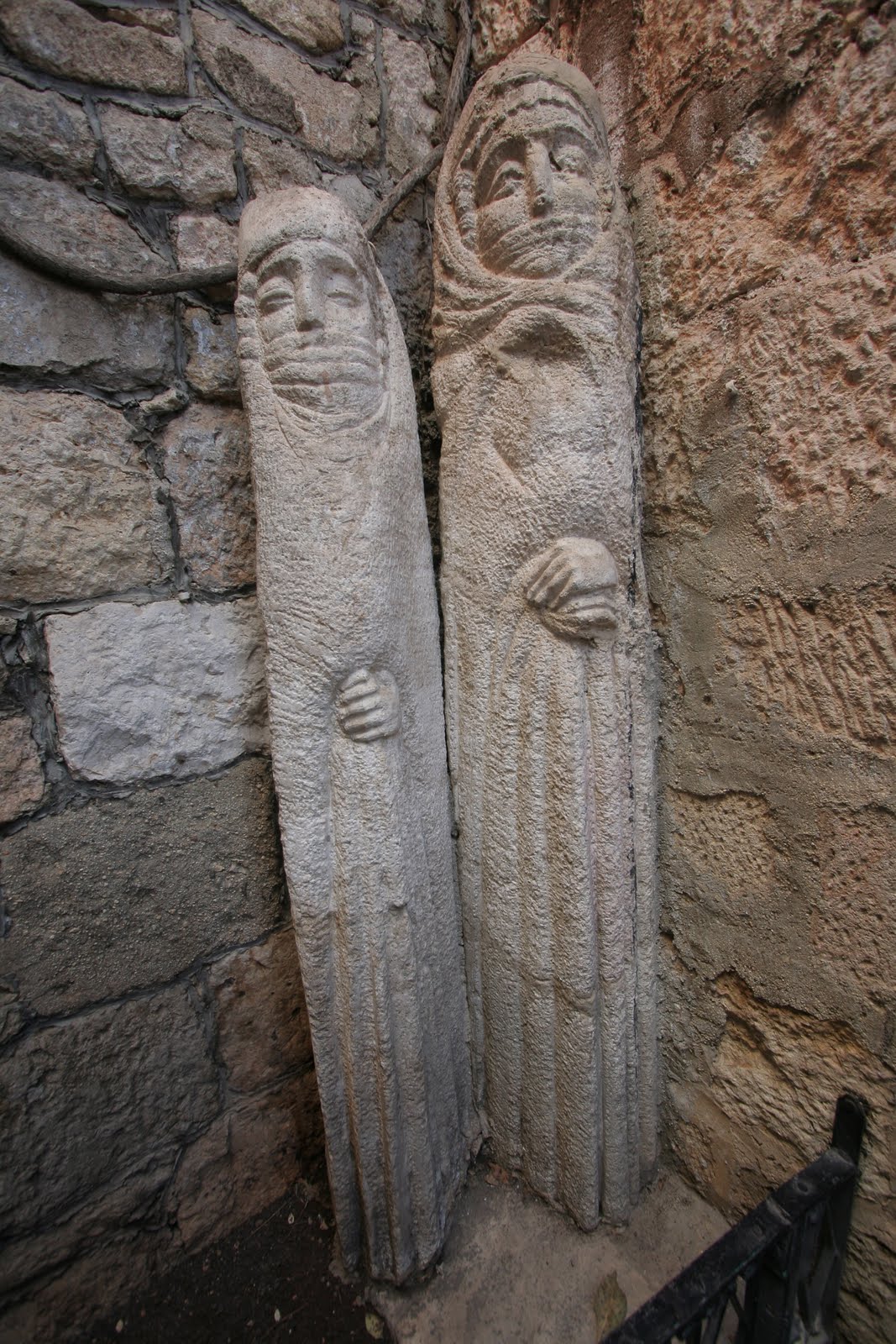
Christian martyrs sister statue in the Christian Quarter


Another opulant bait of the Christiant Quarter, now hotel-restaurant (did I mention the Christians were the wealthier class?)